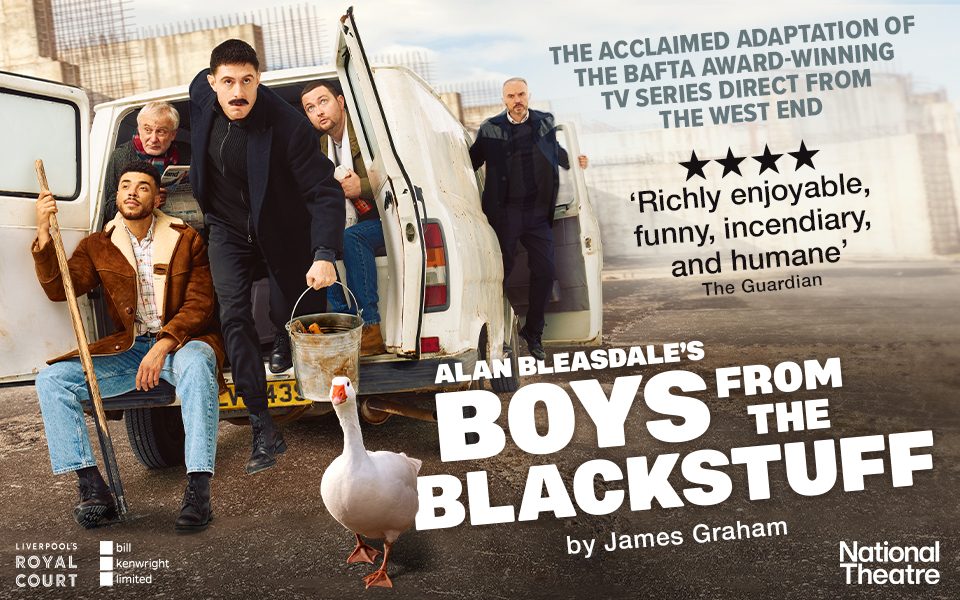
The full title of this production is Alan Bleasedale’s Boys From The Black Stuff by James Graham and is an adaptation of the BBC television series broadcast in late 1982. Two years earlier Alan Bleasedale had written a work for the BBC series of one-off dramas, Play For Today, called simply The Black Stuff, which dealt with a gang of road workers laying tarmac, or black stuff. They were sent to Middlesbrough on a job during which time, one of the characters, Yosser Hughes, arranged for four of them to do a ‘foreigner’ i.e. an unofficial job for cash in hand, ergo no tax records, for a couple of Irish gypsies, and they each invested their savings in the venture. Their legitimate employer discovers this and sacks them. The gypsies, who have also been paid cash for the job, tell the ‘boys’ that they have been paid by cheque and need to need to cash it. Although Chrissie, one of the boys, goes to the bank with Brendan, one of the gypsies, he gives him the slip and disappears as does Dominic, the other gypsy, who Yosser has been holding hostage until Chrissie and Brendan get back, meaning that, not only did they return to Liverpool with no pay for the trip, but also with nothing left in the bank. This caused obvious repercussions to their family life, thus spawning a follow-up series, a not uncommon scenario for the Play For Today franchise.
The collection has come to be associated with the actions of the Margaret Thatcher Government who were elected in 1979, but The Black Stuff, although not broadcast until 1980, was written and recorded in 1978. The Boys From The Black Stuff had been partially written contemporaneously although will have been tweaked to reflect the stringent monetarist policies that regime introduced, causing unemployment to skyrocket from a 70s average of 1 million to 3 million in the early 80s.
By the time the workers had got home, the economy had gone down the pan and things were getting worse. It is difficult to imagine for someone who wasn’t around at the time, just what a dump this country was at the turn of the decade between the 70s and 80s. We were crippled by strikes, the bin men and gravediggers causing rubbish to pile up in the streets – no change there, then – and bodies to be stacked waiting for burial. Lorry drivers were also out and the trucks blockaded ports such as Hull, interfering with the import and export of food. Car plants were idle, and inflation rampant. Even though James Callaghan’s Labour Government had imposed a wage rise cap of 5%, in 1979 Ford gave their workers, who were fairly well paid to begin with, an increase of 27%! Inflation was at 13.4% in 1979 and 18% in 1980. Unemployment was at about twice the rate it is today and was rising quickly.
The television series comprised five episodes, each one concentrating on a particular character, dealing with their individual and family struggles, as well as their interaction with the group, all now unemployed and struggling to find work.

The DHSS staff. Sian Polhill-Thomas as Ms Sutcliffe and Jamie Peacock as Moss.
The first episode in The Boys From The Black Stuff, Jobs For The Boys, follows their attempts to find jobs but, unable to do so legitimately, take some cash-in-hand work on a building site for Malloy, whilst also collecting unemployment benefit. Unsurprisingly, the officials from the Department of Health and Social Security are investigating them and, during a raid, one of the boys, Snowy Malone, falls from an the upper floor to his death.
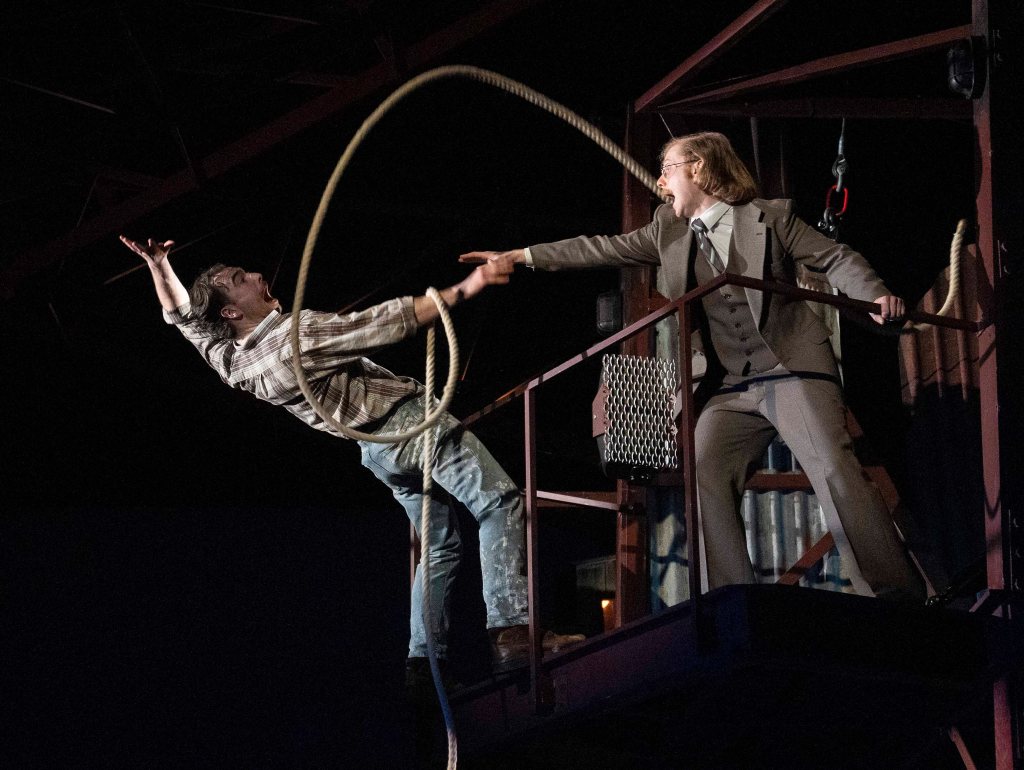
Reiss Barber as Snowy, coming a cropper, despite the efforts of Moss (Jamie Peacock)
Episode Two, Moonlighter, traced the progress of Dixie Dean, who had got a job as a security guard at the docks, where theft from incoming cargo was a way of life. Liverpool was not one of the new container ports and so the goods were unloaded in wooden crates, some of which would ‘break open’ or go missing altogether. Usually those containing booze or cigarettes. He is coerced by the gang responsible for the robberies into turning a blind eye to their activities, which he reluctantly does. This episode also covers the reunion of the surviving boys at Snowy’s funeral.
Shop Thy Neighbour concerns Chrissie, who has been put under extreme pressure from the benefit fraud investigation. His marriage is also under strain as they run out of both food and money, his payments having been frozen during the investigation. He eventually kills his chickens and geese to provide meat. It also covers his friendship with Longo, another one of the gang.
Yosser’s Story is probably the most infamous of the quintet, dealing with Yosser Hughes, who is trying to avoid losing his children, his wife having already left him. The Middlesbrough escapade has resulted in him having a mental meltdown which continues with dire consequences. He spends most of this, and other episodes approaching strangers, who are obviously working, and harassing them saying ‘I could do that – gizza job, go on, gizza job!’ The conversation often ends with him head butting them.

Yosser, Jay Johnson, being restrained by Loggo (Jurell Carter) and Dixie (Mark Womack)
The final episode deals with the oldest of the boys, George, whose health is quickly deteriorating, confining him to a wheelchair. He is the confidante of the group handing out measured advice to his juniors. He finally gets Chrissie to wheel him to the docks where he stands up one last time before sitting back down in his wheelchair and dying.

George Caple as Chrissie, taking George (Ged McKenna) to the docks for the final time.
Obviously, a couple of hours is nowhere near long enough to recreate the complete canon so the format has been changed from being episodic, to chronological. The problem is that The Black Stuff was pivotal in the tale and references were constantly being made to Middlesbrough, which meant nothing to those who had not seen the Play For Today. In due course there was a flashback to partially explain, but it seemed very clumsy in its timing and execution.
Speaking of execution, there was an incident in the first half which caused the play to be paused for several minutes. It was during the DHSS raid when Snowy plunges to his death. It was depicted by a projection at the rear of the stage, of a body descending, but it occurred before the action of his struggle with the investigator took place. Oops! To be fair, press nights are usually on the first night of the run in order to give us a chance to post our articles while the play is still at the venue, so the sets and tech need to be set up in a strange building which is probably a different size and shape to the preceding week’s so I am surprised at how very rarely this happens. It was sorted out reasonably swiftly and Snowy got a stay of execution for a few minutes.
Other than that, the sound and lighting were very evocative, although I was occasionally confused by the set, which was dark and only occasionally resembled a building site. The rest of the time it was furnished with rusty metal box-like structures, the odd house interior and, oddly, when they all arrived at the DHSS office, a form of numbered compartments making the boys look like greyhounds in the traps.
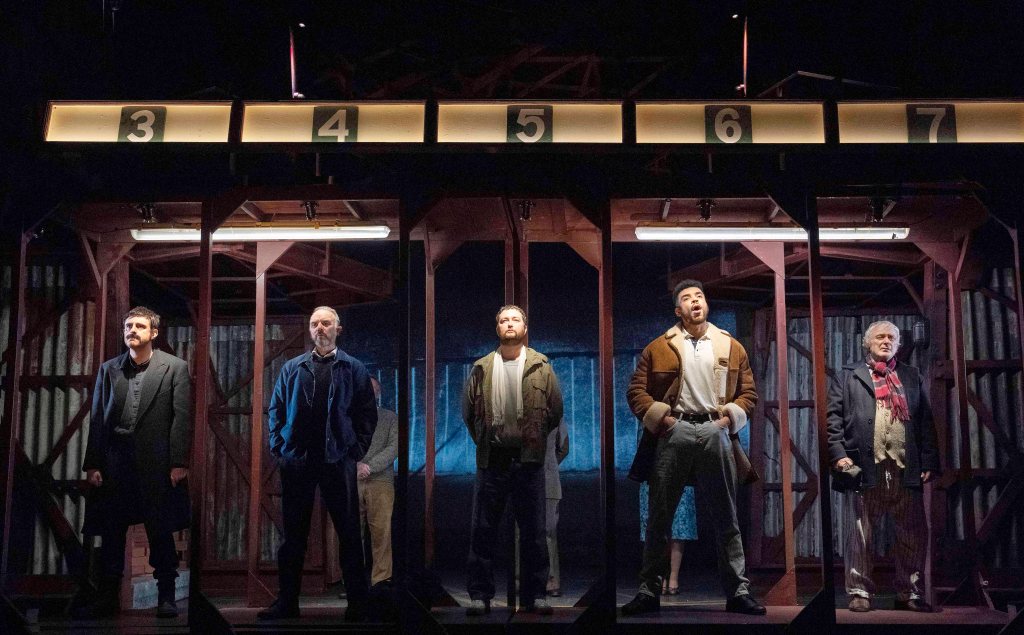
Ready for the hare to start running. Trap 3, Jay Johnson as Yosser Hughes – Trap 4, Mark Womack as Dixie – Trap 5, George Capel as Chrissie – Trap 6, Jurell Carter as Loggo – Trap 7, Ged McKenna as George.
The acting was extremely good all round, but I couldn’t help feel sorry for Jay Johnson, who took the part of Yosser, a character which has become indelibly associated with Bernard Hill who sadly died a year ago, almost to the day. He did give it a great shot, but again, was burdened by the need to physically resemble Mr Hill, in that he had to sport a black moustache. This was not as an imitation for its own sake, but because one of Yosser’s iconic moments in the series was when he approached the then Liverpool FC star player, Graeme Souness, to ask him for a job, comparing their facial hair and saying ‘I could do that, gizza job.’

Jamie Peacock as Moss with Amber Blease, here as Lawton, but who also played Angie.
Some of the actors were called upon to fill several parts, most notably Amber Blease, who was brilliant as Angie, the wife of Chrissie, who displayed all the angst associated with having a husband whose moral compass compelled him to refuse to take a legitimate job with Malloy, whilst his ex-workmates were still unemployed. A kind of imposter syndrome. She also played a student, a clerk, two other women and a lollipop lady who got the Yosser treatment.
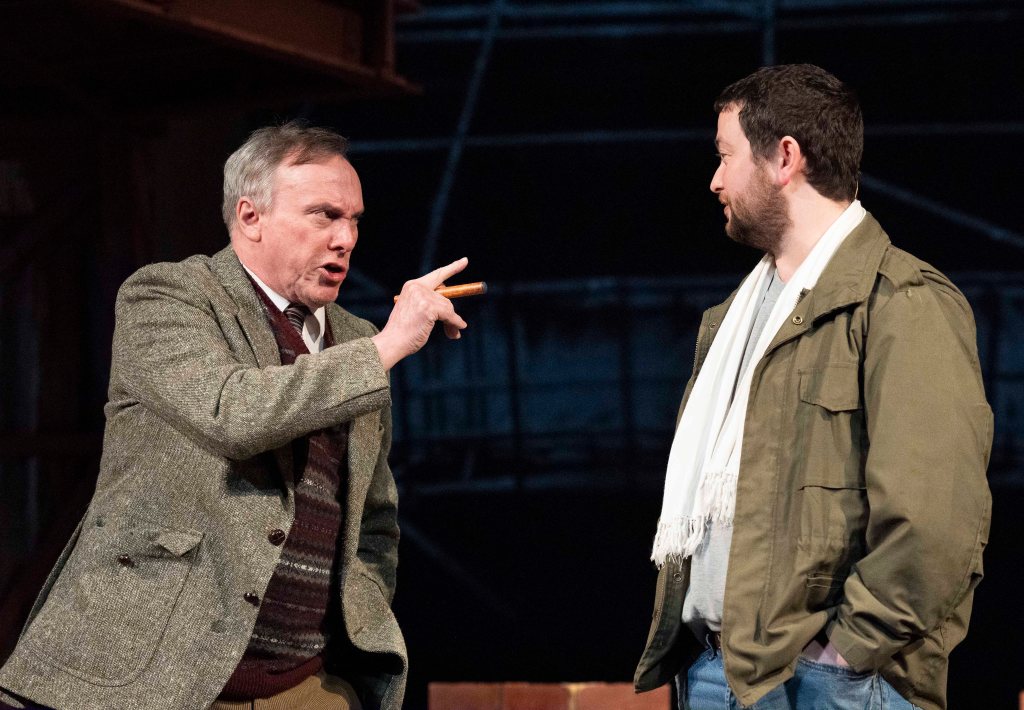
Sean Kingsley as Malloy, offering Chrissie, George Capel a proper job.
There were some very powerful scenes but also some which I found to be really annoying. All authority figures were depicted as imbeciles, whereas the gang held up as heroes. I realise that some of the best drama has used the villain of the piece as the hero, most notably, Tony Soprano, who wasn’t content to stop at the odd head butt, however, these ‘heroes’ were depriving honest, unemployed workers of jobs, so basically being traitors to their class.
All in all, I felt as though sleeping dogs should have been left to lie. The way of the world has changed so radically in the last 40 years that, unless you were there, it is almost impossible to grasp the nuances of life in England at that time.
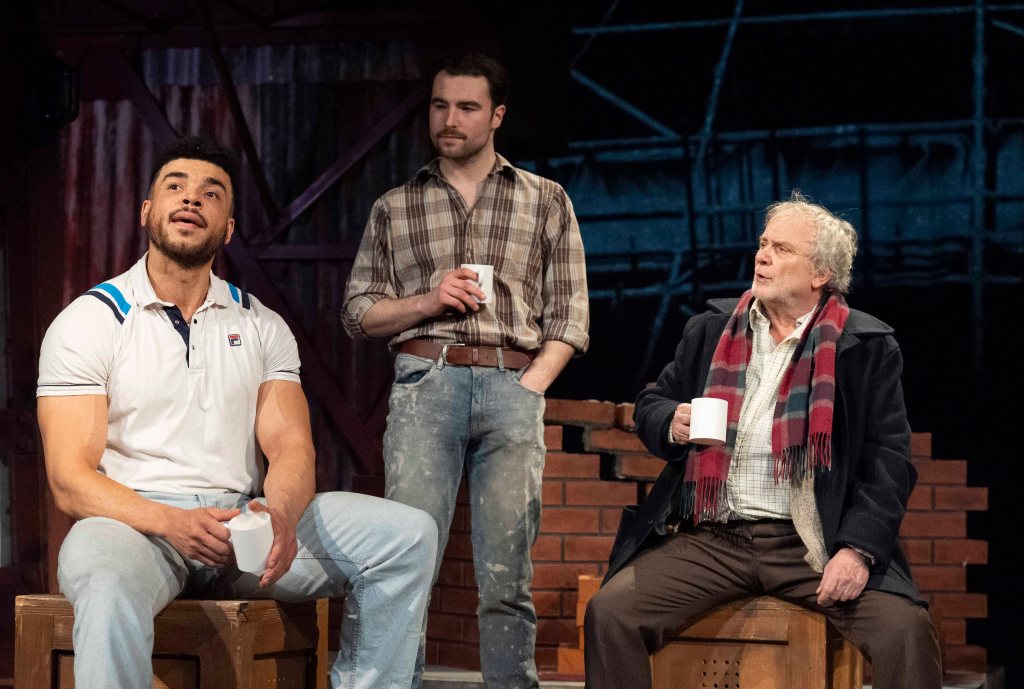
Sometimes you need a break from defrauding your fellow man. Jurell Carter as Loggo, Reiss Barber as Snowy and Ged McKenna, George.
The programme carries an interview with Alan Bleasedale and James Graham – no relation – the former of whom said that he wouldn’t have been able to adapt his work for the stage, but seemed happy with the job done by Mr Graham. I am afraid I have to disagree with the great tv writer and say that I found it disjointed, ineffectual and irrelevant to the present day – except for the strikes and abysmal customer service. The ending was also by far the weirdest, most incongruous thing I have seen in a long time.
Boys From The Black Stuff runs at Leeds Grand Theatre until Saturday, 17th May. For more details and booking, please go to https://leedsheritagetheatres.com/whats-on/boys-from-the-blackstuff-2025/
For other productions coming to Leeds Heritage Theatres have a look at https://leedsheritagetheatres.com/whats-on/
Photographs by Alastair Muir
 Tyke It To The Limit